The brief
Capright brought team members from across the U.S. and Latin America together for a company conference in Fort Worth, the kind of in-person gathering that, in a relationship-driven industry, does the work no video call can. Leadership wanted to capture that energy while everyone was in one room, and they wanted it in a format their audience already follows: On the Spot, Capright’s conversation series.
The ask wasn’t a single sit-down. It was a run of episodes, recorded back-to-back over the conference, each one a genuine conversation between Capright voices. That meant we couldn’t treat it like a one-off shoot. We needed a repeatable set; one that could turn over guests quickly, hold broadcast quality across every take, and never become the thing the conference was waiting on.
There was just one catch: there was no room for it. So we made one.
The approach: a set, built where there wasn’t one
We didn’t have a studio or a spare conference room to work with. What we had was a corner of a hallway and a glass wall looking straight out at downtown Fort Worth. So we set-dressed the corner into a clean, intentional little set and used that glass wall as the backdrop, putting the Fort Worth skyline behind the speakers in every frame. What started as pass-through space ended up looking like a room designed for exactly this.
A podcast lives or dies on two things does it sound clean, and does it look like a conversation you’d actually want to sit in on. We engineered both before a single guest sat down.
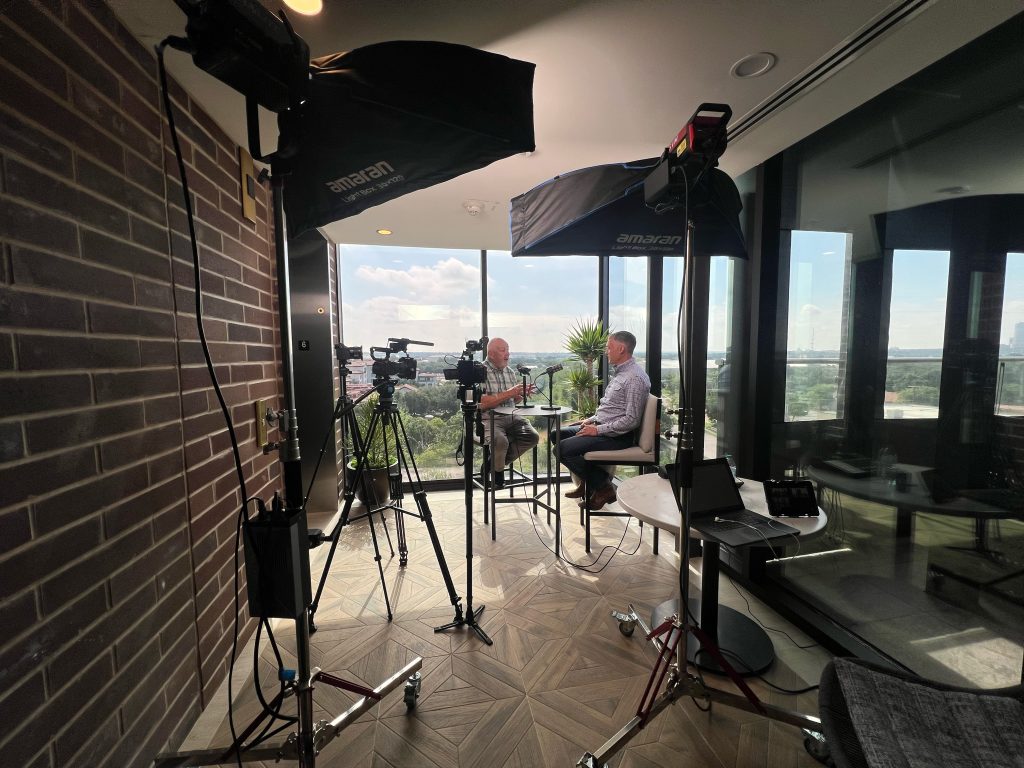
Three cameras, three jobs. We ran a Sony FX3, FX30, and a7 V as a coordinated multi-cam rig: a dedicated angle on each speaker plus a wider framing to hold the two-shot and to let that skyline read giving the edit room to breathe. With matched color and framing across all three bodies, every cut feels intentional rather than reactive the difference between footage and a show. The cinema-line FX3 and FX30 gave us the depth and latitude to balance the bright window against the speakers and keep the city sharp behind them, and the a7 V rounded out coverage without compromising the look.
Broadcast audio, no compromise. Audio ran through a RØDECaster Pro console feeding two RØDE PodMics, the same dynamic, broadcast-style mics and mixing setup the best independent podcasts are built on. Levels were dialed and monitored live, so what came off the board was clean, balanced, and ready. No salvage work in post, no “we’ll fix it later.” It was right in the room.
Turnover built for a conference schedule. The whole point of a fixed set is speed between guests. Once it was dressed and the rig was locked, swapping speakers took minutes, not setups. That let Capright keep their conference moving and still walk away with a full slate of episodes.
The output: nine episodes
Across the engagement we produced nine On the Spot episodes, each a self-contained conversation ready for Capright’s channels. Consistent look, consistent sound, consistent feel a body of content that reads as one series, not nine separate shoots.
Featured episode – “Boots, Jeans, & AI”
The flagship conversation paired host Stephen “Steve” Williams with Capright CEO Jay Marling for a wide-ranging talk on where commercial real estate is headed.
The through-line was a simple one: in an industry built on relationships, expertise, and trust, there’s no substitute for being in the room together. Steve and Jay dug into why the conference mattered — the value of bringing valuation professionals, market experts, and stakeholders face-to-face to exchange ideas and pressure-test assumptions and the culture that keeps fueling Capright’s growth across the U.S. and Latin America.
They also mapped the forces reshaping CRE right now: the rising premium on data-driven decision making, shifting investor expectations across asset classes, the role of genuinely independent valuation and advisory work, and the opportunities surfacing even amid economic uncertainty. The takeaway that trusted, independent market intelligence matters most exactly where the stakes are highest is one that translated cleanly to camera precisely because the conversation was real and the production stayed out of its way.
Why it worked
This is the kind of project where the production has to be invisible. The audience should feel the conversation, not the camera package behind it and they shouldn’t be able to tell the set was a hallway an hour earlier. A locked, three-camera rig, a properly mixed audio console, and a skyline backdrop pulled out of the room we were already standing in meant Capright’s people could simply talk and trust that the result would look and sound like the caliber of firm they are.
That’s the difference between a vendor who shows up to shoot and a media partner who builds the system the content runs on even when the room doesn’t come with one. We delivered the second one.